


Glossary
Air: Sufficiently dry air, not causing water droplet formation within the pressure environment of the switch
Assembly instruction: Some pressure switches only guarantee the given tolerance for a certain orientation of the switch. Always adjust set points in the same orientation, which is later used, to avoid negative influences on tolerance.
Burst pressure: High pressure level, causing the switch to leak medium.
Connection: Linking the switch with the pressure system. Depending on the type of switch there is either a single connection, two connections for sensing pressure differences or more connections for special applications. For low pressure the connection is usually a simple plug, e.g. outer diameter 4mm, for high pressure a screw connection, e.g. Whitworth G 1/4“ or G 1/8“ is being used. Different connections than offered can be supplied.
Contact arrangement: Type of switch: Single pole, double throw; Single pole, single throw, normally open or single pole, single throw, normally closed. Single pole, double throw switches first terminate the connection before creating the new one. The central position is not mechanically stable though.
Degree of protection: Degree of protection according to DIN EN 60529, with included covers and caps unless stated otherwise.
Differential pressure switch: Pressure switch, which senses the difference between two pressure levels at two connections.
Electrical contacts: Typically 1 mm pins, 6.3 mm flat or Metri-Packs. Other types on request.
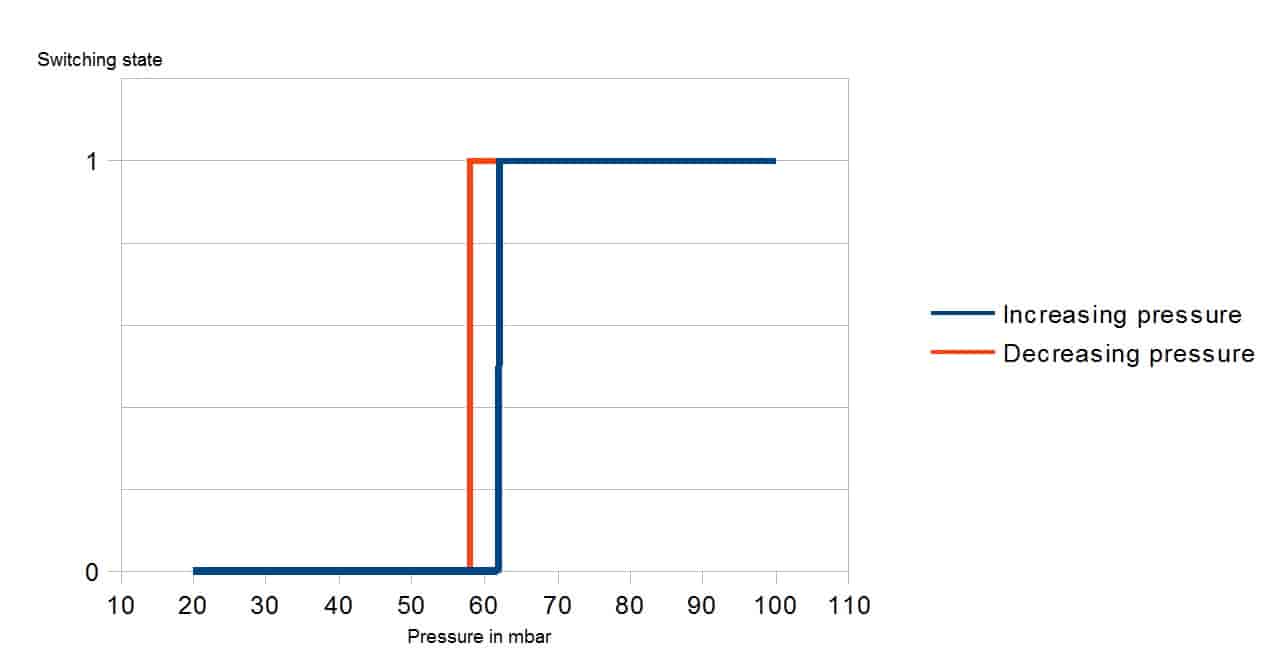
Hysteresis: Pressure switches open and close at different pressure levels. This behavior is caused by the force of the electrical current as well as mechanical forces and is in general desirable. It creates a more stable electrical behavior and also reduces the number of cycles, increasing the life expectancy of a switch. On the other hand, if the hysteresis is too large, there is an increasing grey area where the switching position can no longer be clearly deduced from the pressure level. Each switch therefore has two different graphs, one for increasing, the other for decreasing pressure. Switches with large hysteresis and low requested set point deviation therefore have to be calibrated with the correct graph. Example showing the relationship of pressure and switching position for both graphs: For increasing pressure the switching position is at 62mbar, for decreasing pressure it is at 58 mbar.
Initial resistence: Internal resistence of the new switch. During the life cycle of the switch the resistence increases as each cycle increases wear.
Maximum current: The number of switching cycles is rated for a current at a given voltage. Higher currents lead to increased wear or instant failure of the switch.
Maximum operating pressure: Highest pressure that does not cause a change of the switching point
Medium: Gases and liquids suitable for a given pressure switch
Non-hazardous gases: In normal conditions (and operating conditions of the switch) not combustible, not agressive, not a solvent. Examples other than air: Nitrogen, oxygen, inert gases, carbon dioxide
Operating temperature: Temperature range, in which the switch is achieving the stated numbers of cycles and level of tolerance.
Proof pressure: Highest pressure the switch can sustain without taking permanent damage. Proof pressure is just short of the pressure necessary to permanently deform parts of the switch. Set point integrity cannot be guaranteed.
Pressure switch: Switch, which opens or closes upon reaching a certain pressure level on a single connection.
Size: Overall size of the switch. Size of switches with included rubber caps, without the caps.
Switching point: Pressure level, which causes the switch to cycle.
Tolerance: Acceptable deviation of the switching point from the set point due to expected influences (e.g. temperature, sustained pressure loads, electrical current, medium). When changing the set point in the field, it is advised to expose the switch to the expected conditions.
Vacuum: Negative pressure, pressure below surrounding pressure or reference pressure.
Vacuum switch: Pressure switch for sensing negative deviations of the environmental pressure